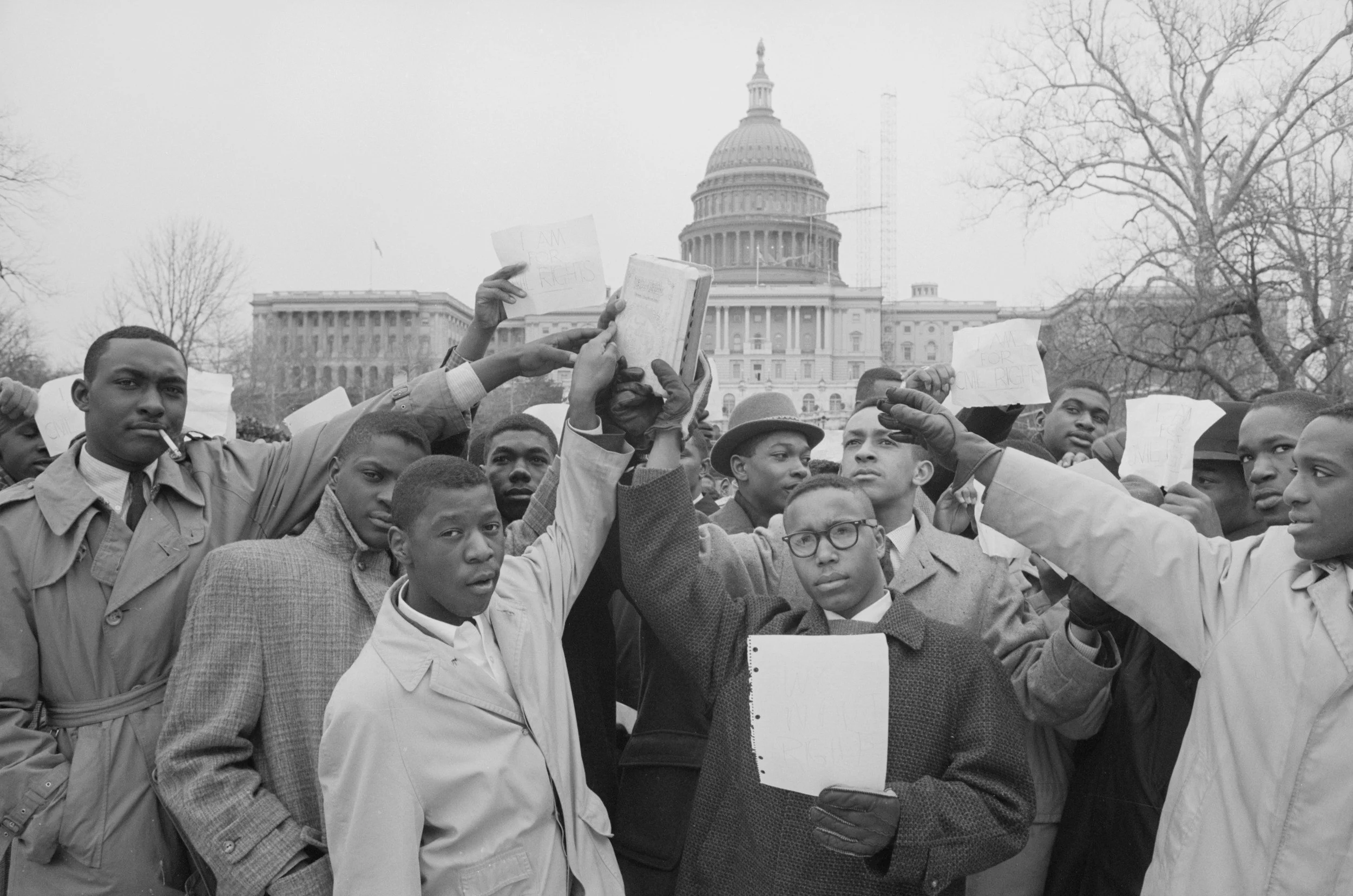
Civil Rights Advocacy After World War II
While the end of World War II seemingly brought peace for all, the struggles of minority groups in America persisted well beyond the war, with many questioning if they could bring home the democracy they had fought for abroad. During the years following World War II, the return of African American veterans advocating for desegregation and the increasing efforts of highly decorated Mexican American servicemen enhanced their respective communities’ protests for equality, although deep-rooted prejudices hindered the immediacy of social changes until decades later.
Returning African American veterans used their military status to challenge discrimination and helped further expand the civil rights movement, although racism continued to oppress African American veterans. Isaac Woodard, a veteran returning from the war to his home in the South, was brutally blinded by a local police officer for talking back to a white bus driver; his blinding attracted federal attention and spurred Truman policy actions. The NAACP funded Isaac Woodard on a speaking tour of America; his speeches about his service and blinding were particularly powerful. A month after the police officer was acquitted by an all-white jury, Truman signed an executive order creating the President’s Committee on Civil Rights and, later, Executive Orders 9980 and 9981 to desegregate the American federal workforce and military, respectively. Thus, the horrific blinding of Isaac Woodard catalyzed a national consideration for the injustice of Black veterans who had protected America against fascism abroad only to be attacked by racists at home. Furthermore, while Black veterans saw some success in using their newfound status after the war to act against discrimination, they still faced unfair treatment under policies such as the Servicemen’s Readjustment Act, also called the G.I. Bill, which slowed overall African American economic progress and inhibited education opportunities—major contributors to the success of funding civil rights advocacy. Due to pushback from Southern Democrats, the G.I. Bill gave state and local officials the power to choose who received its benefits. In Mississippi, Black veterans received only two home loans out of a total 3,200 granted. The stark disparity in loan approvals demonstrates that African Americans—veterans and consequently their families and the wider community—were denied the privileges promised to them, delaying their economic progress for decades. All in all, while African American veterans saw little economic and educational success in policies like the G.I. Bill, they were able to bring about a few meaningful legal changes, enhanced by their veteran status, as seen in the case of Isaac Woodard, strengthening civil rights advocacy.
Mexican American veterans leveraged their distinguished combat status to form active organizations that successfully challenged segregation in various public facilities and forums. In 1949, the remains of decorated soldier Felix Longoria were denied a burial in his hometown, an incident that would later propel the American GI Forum to the forefront of Mexican American civil rights activism. In a letter responding to the GI Forum’s complaint about the exclusion of Longoria’s body, Senator Johnson offered a burial at Arlington National Cemetery with all expenses covered. By involving then-Senator Johnson and securing a military burial at Arlington National Cemetery, the American GI Forum shifted from a local reform group to a more national force, effectively increasing their political influence and raising Mexican American social status. The case of Felix Longoria, ultimately a victory, expanded social activism across the Mexican American community to fight segregation and other discriminatory practices. In addition, rising organizations like Alianza Hispano-Americana—chiefly driven by veterans—thrived in the Mexican American community. Their success included winning the 1951 case Gonzales v. Sheely, where theyargued that the segregation of Mexican American children in Tolleson, Arizona, was a violation of the Constitution. Even after the court’s decision, Alianza continued to fight against segregation of Mexican American children in Arizona. Alianza successfully secured legal change on broader state and national scales, although—as with Longoria and African American activism previously—actual change continued to be a fight. Overall, from winning state-level legal challenges and national recognition to fighting local discrimination, Mexican American veterans used their wartime skills and decorated status to contribute to the growth of the Mexican American civil rights movement, paving the way for future equality.
After World War II, the return of African American and Mexican American veterans advocating for civil rights movements intensified challenges to racial hierarchies in American society; the resulting changes were largely local, with major nationwide success not emerging until decades later. For African Americans, the seeds planted by post-World War II struggles, such as increases in NAACP membership, grew into landmark legislation in the mid-1960s with efforts by groups such as the Southern Christian Leadership Conference (SCLC) and Student Nonviolent Coordinating Committee (SNCC). The laws of the mid-1960s gave equal access to public facilities and voting, among other basic rights. Similar to African American veterans, Mexican American veterans devoted their efforts in numerous activist organizations, focused on community efforts and legal changes. The Civil Rights Act of 1964 and Voting Rights Act of 1965, although mostly driven by Black protesters, were major pieces of legislation for Mexican American civil rights as well.
The theme of widespread veteran involvement and involvement in wars is still significant for advocacy by minority groups today; while outright discrimination and segregation have decreased in modern American society, many minority groups still face erasure of cultural history and lack of proper recognition and respect in American society.